Defense & Aerospace Power Blog
Engineering updates, technical articles, and industry insights on rugged military power supplies, VPX modules, and custom power conversion solutions.
What Are the Top 10 Embedded Computing Power Supplies?
Table of Contents
- How Embedded Power Supplies Are Classified by Output, Input, and Form Factor
- Which Safety Standards Apply: IEC 62368-1, IEC 60601-1, and EN 50155
- How 12 V, 24 V, and 48 V Rails Shape the Top 10 Supply Choices
- How to Compare Efficiency: 80 PLUS Requires at Least 80% at Key Load Levels
- Where the Top 10 Fit: SBCs, COM Express, Industrial PCs, and Edge AI
- FAQS
- Conclusion
- Related Posts
Embedded Computing Power Supplies sit behind reliable operation in industrial PCs, edge gateways, control panels, and compact servers. Their job seems simple: convert available power into stable rails. The details are less forgiving. A brief voltage dip, excess heat, or poorly matched connector can interrupt a system that otherwise looks well designed.
This guide examines ten notable supply options for embedded computing, using practical factors rather than a single headline rating. It considers input range, output capacity, efficiency, thermal behavior, isolation, protection features, mounting style, and documentation. Fit matters. A high-wattage unit may be the wrong choice for a fanless enclosure, while a smaller converter may suit a space-constrained controller. Datasheets help, but they cannot fully reproduce an installation’s airflow, load profile, or electrical noise. That deserves attention.
The products are intended as a useful shortlist, not a universal ranking for every design. Selection should begin with the host computer’s actual voltage and peak-current needs, then account for startup surges, temperature, and available space. Check derating curves and certifications against the project’s requirements. Also confirm connector polarity and wiring details before integration. Small oversights can become expensive.
Power quality is only one part of reliability. Service life, supply-chain continuity, and replacement availability matter too. Some specifications look reassuring until conditions change. Engineers should verify critical limits with bench testing and the manufacturer’s current documentation. The comparisons that follow aim to make that evaluation clearer, while acknowledging that the best choice depends on the system around it.
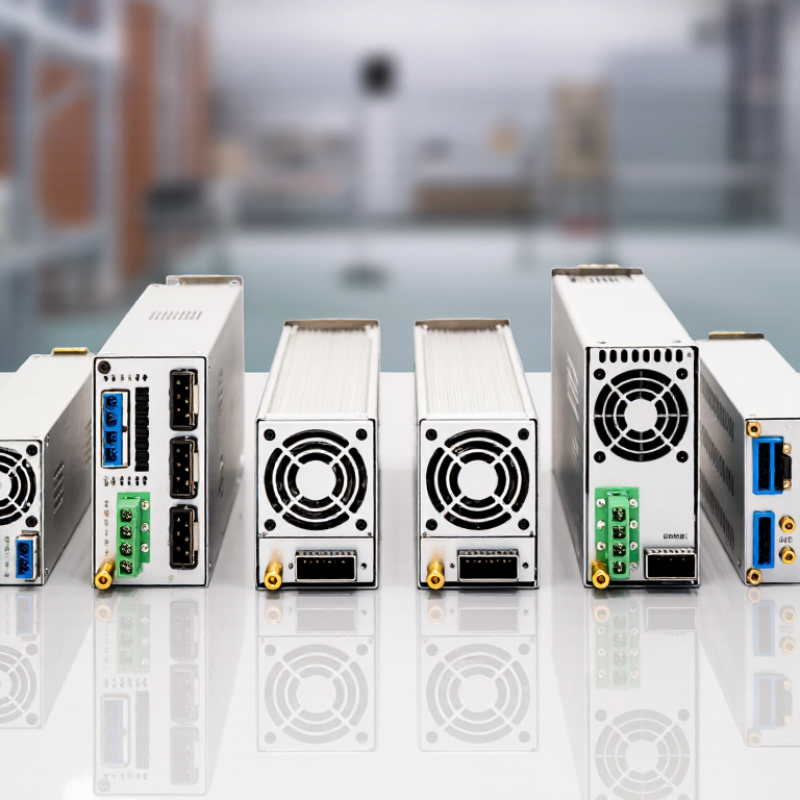
How Embedded Power Supplies Are Classified by Output, Input, and Form Factor
Embedded computing power supplies are easier to compare when grouped by output, input, and physical form. These categories overlap, so one unit may fit several descriptions. That can make a “top ten” list less tidy than it sounds.
By output, common types include fixed-voltage DC supplies, adjustable DC supplies, multi-output units, and AC-output inverters. Low-voltage DC rails often serve processors and sensors, while separate rails may support storage or fans. Check continuous wattage, peak demand, ripple, and regulation under changing loads. Small details matter. A supply that meets the nominal voltage may still cause resets when a processor briefly draws more current.
Input classification covers AC-input, DC-input, and wide-range units that accept more than one input voltage. Battery-powered systems need attention to voltage variation during charging and discharge. Some applications also require galvanic isolation; verify this in the specifications rather than assuming it from the label.
Form factor describes installation: board-mounted converters, enclosed modules, open-frame supplies, DIN-rail units, and external adapters are common options. Compare dimensions, connector placement, cooling, and access for maintenance. An open-frame design may fit a tight enclosure, but airflow and accidental contact deserve careful review. The “best” format depends on the cabinet and operating conditions, not just its rated power.
Which Safety Standards Apply: IEC 62368-1, IEC 60601-1, and EN 50155
Choosing among the top ten embedded-computing power supplies is not just a wattage contest. The right safety standard depends on the finished equipment and its use, not only the converter label. IEC 62368-1:2023 applies a hazard-based approach to ICT equipment, assessing risks such as electric shock, fire, and excessive heat. IEC 60601-1:2005+A1:2012+A2:2020 addresses medical electrical equipment, where isolation and leakage current are critical. For AC patient leakage, its Table 3 sets Type BF limits at 100 µA in normal condition and 500 µA under single fault. Type CF limits are tighter: 10 µA and 50 µA. Test conditions matter.
Railway systems bring different demands. EN 50155:2021 covers electronic equipment used on rolling stock, including environmental and supply-related conditions. IEC 61373 provides vibration and shock test methods that may also be relevant. A certificate alone tells only part of the story. Check the supply’s intended-use approvals, insulation details, test reports, and temperature derating curve. A 24 V rail that dips during a supply interruption can reset a computer, even when the rated wattage looks ample. That’s the catch. A standards matrix helps compare candidate supplies against the complete system, including its enclosure, wiring, and operating environment.
What Are the Top 10 Embedded Computing Power Supplies? - Which Safety Standards Apply: IEC 62368-1, IEC 60601-1, and EN 50155
| No. | Power-supply type | Typical input | Typical output range | Common embedded uses | Standards relevance and selection notes |
|---|---|---|---|---|---|
| 1 | Enclosed AC–DC power supply | 85–264 V AC, 50/60 Hz | Approximately 20–300 W; common DC rails include 5, 12, 24, and 48 V | Industrial computers, network appliances, and control systems | IEC 62368-1 may apply to the finished ICT or AV equipment. IEC 60601-1 is relevant when the finished equipment is medical electrical equipment. EN 50155 is relevant to railway rolling-stock electronic equipment, not a general substitute for a product safety standard. |
| 2 | Open-frame AC–DC power supply | Typically 85–264 V AC, 50/60 Hz | Approximately 5–500 W, depending on size, cooling, and design | Embedded boards, appliances, instrumentation, and equipment with an internal chassis | Assess safety in the final enclosure and end-equipment context. IEC 62368-1, IEC 60601-1, or railway requirements may be relevant depending on the finished product and its intended use. |
| 3 | External AC–DC adapter | Typically 100–240 V AC, 50/60 Hz | Approximately 5–300 W; often supplied at 5–48 V DC | Small computers, gateways, displays, and portable embedded devices | Check both adapter approval and finished-equipment requirements. IEC 62368-1 commonly applies to ICT/AV equipment; medical equipment may require evaluation under IEC 60601-1, including the power path and system configuration. |
| 4 | Isolated DC–DC converter | Common nominal input families include 12, 24, or 48 V DC; wide-input models vary | Approximately 1–300 W; often converts between DC rails | Distributed power systems, isolated interfaces, and equipment powered from a DC bus | Isolation rating alone does not establish compliance with IEC 62368-1 or IEC 60601-1. The required safeguards depend on the end product, isolation barriers, working voltage, and application. |
| 5 | Non-isolated point-of-load regulator | Usually a low-voltage DC bus, such as 5, 12, or 24 V | Typically sub-watt to tens of watts per rail; commonly steps down to processor and memory voltages | Single-board computers, embedded processors, FPGA systems, and sensor modules | Normally treated as a component within the end equipment rather than a standalone safety-certified supply. The host equipment’s applicable safety standard governs the overall design. |
| 6 | Wide-input railway DC–DC converter | Railway battery buses may be nominally 24, 48, 72, or 110 V DC; permitted ranges depend on the application | Approximately 10–300 W for many embedded loads | Onboard computers, communications equipment, monitoring systems, and control electronics | EN 50155 addresses electronic equipment used on railway rolling stock, including relevant supply and environmental conditions. It is not, by itself, a general electrical safety standard; determine the applicable product safety requirements separately. |
| 7 | Medical AC–DC power supply | Typically 100–240 V AC, 50/60 Hz | Approximately 5–300 W across common embedded applications | Patient monitors, diagnostic equipment, and medical devices with internal power conversion | IEC 60601-1 is the medical electrical equipment safety standard commonly assessed for the finished equipment. Required means of protection depend on the applied parts, patient environment, and system design; verify the applicable edition and national adoption. |
| 8 | Medical isolated DC–DC converter | Typically supplied from an existing DC bus, often 5–48 V DC | Approximately 1–60 W in many board-level applications | Patient-connected subsystems, isolated measurement circuits, and internal medical-device rails | IEC 60601-1 assessment depends on the complete medical system and its protection architecture. Do not assume a converter’s isolation specification alone provides the required means of patient protection. |
| 9 | Redundant or hot-swap power module | Commonly AC mains or a DC distribution bus, depending on system design | Approximately 100 W to several kilowatts per module or system | Industrial servers, telecom and networking equipment, and high-availability control systems | IEC 62368-1 may apply to ICT/AV equipment as a whole. Evaluate the complete assembly, including redundancy, wiring, protective devices, temperature, and enclosure—not just each module in isolation. |
| 10 | Battery charger and UPS power module | AC mains, DC input, or a combination, depending on architecture | Approximately 5–500 W for many embedded systems; higher-power systems are available | Portable computers, remote monitoring units, industrial controllers, and backup-powered gateways | IEC 62368-1 may be relevant for ICT/AV equipment; IEC 60601-1 may be relevant for medical equipment. Battery, charger, and system-level requirements must also be considered for the product and market. |
Important: IEC 62368-1 applies to relevant audio/video and information and communication technology equipment; IEC 60601-1 applies to medical electrical equipment; EN 50155 covers electronic equipment used on railway rolling stock. Which requirements apply depends on the finished product, intended use, installation, and target market. Confirm the current applicable editions and any additional national, sector, or system-level requirements with a qualified compliance specialist.
How 12 V, 24 V, and 48 V Rails Shape the Top 10 Supply Choices
The top ten embedded supply choices are not universal; rail voltage sets current, wiring, and thermal demands. Open Compute Project’s Open Rack V3 specification uses a 48 V DC distribution bus. Consider a 480 W load: at 12 V it draws 40 A, while at 48 V it draws 10 A. With equal cable resistance, the 48 V run produces one-sixteenth the resistive loss. A useful detail. Real connectors and converters add losses, so this calculation is only a starting point.
For compact boards and legacy modules, 12 V supplies remain practical; 24 V DIN-rail and enclosed supplies suit many control cabinets and sensor networks. The 48 V options—AC/DC units, DC/DC modules, and bus converters—fit higher-power loads or longer cable runs, provided the downstream electronics accept the voltage. USB-IF’s USB Power Delivery 3.1 specification also defines up to 240 W at 48 V, showing how higher-power designs can use that rail. It is not a substitute for checking embedded load requirements. Compare derating curves, startup current, isolation, and connector ratings, not just headline watts. I would not rank one rail above another without the actual cable length and load profile; that missing detail often changes the answer.
What Are the Top 10 Embedded Computing Power Supplies?
How 12 V, 24 V, and 48 V rails shape common supply choices
The chart shows nominal input-bus voltage for ten common supply configurations; it is not a ranking or a power-rating comparison. A 12 V, 24 V, or 48 V bus can feed a regulated supply directly or be stepped down by a DC/DC converter. The appropriate choice depends on the load, wiring, efficiency, and system requirements.
How to Compare Efficiency: 80 PLUS Requires at Least 80% at Key Load Levels
When comparing embedded computing power supplies, efficiency shows how much input energy becomes usable DC output. The rest is mostly heat. An 80 PLUS rating indicates that a unit meets a minimum efficiency threshold at specified load levels. The familiar baseline is at least 80 percent at key test points, though requirements vary by certification category and test conditions. Check the exact rating and input voltage before comparing two units. A percentage without its test context can mislead.
In an embedded system, load changes matter. A controller may idle lightly, then draw more power when processors, storage, or attached devices become active. Compare efficiency near the system’s usual operating load, not only at a peak figure. A small fanless enclosure can make wasted heat especially noticeable. Still, certification alone does not establish reliability, voltage stability, or performance during sudden load changes. I would not treat one efficiency number as a verdict; that shortcut is tempting, and sometimes wrong. Check thermal limits and power behavior under realistic workloads, too.
Where the Top 10 Fit: SBCs, COM Express, Industrial PCs, and Edge AI
For single-board computers, the best-fit supplies are often compact regulated DC inputs, USB-C power delivery, or small isolated DC-DC converters. The right choice depends on the board’s input range, peak load, and attached peripherals. Small boards are unforgiving. A camera, radio, or storage device can create brief current spikes that a marginal adapter cannot handle. Check voltage at the board under load, not only at the supply terminals.
COM Express designs usually need a carrier board and a carefully matched DC-DC stage. Wide-input converters help when equipment faces changing vehicle or cabinet voltages. Industrial PCs may instead use internal ATX supplies, DIN-rail AC/DC units, or redundant power modules. Isolation matters where field wiring introduces electrical noise. So does thermal derating: a supply rated for a cool test bench may deliver less inside a sealed cabinet. Measure it in place.
Edge AI systems add accelerators, fast storage, and multiple network interfaces, so high-current low-voltage supplies and transient-tolerant designs become more relevant. Power-over-Ethernet can suit compact, lower-power nodes; it is not a universal answer for accelerator-heavy boxes. For remote installations, hold-up capacity or a small backup supply can prevent abrupt shutdowns. The awkward part is that workload peaks are easy to underestimate. Test the actual model, sensors, and networking together, then leave sensible headroom.
FAQS
They can provide fixed or adjustable DC, multiple DC outputs, or AC output. Input and mounting style create other categories.
Match the rail to the equipment, cable length, and load. A 480 W load draws 40 A at 12 V, but 10 A at 48 V. The right choice still depends on the full system.
Check continuous power, peak demand, ripple, and voltage regulation. A processor’s brief current spike can cause resets. Test under real load.
A regulated DC supply or a small converter may fit. Check the board’s input range and connected devices. A camera or storage drive can create sudden current spikes.
Internal supplies, cabinet-mounted units, and redundant modules are common options. Check isolation and heat limits. A sealed cabinet can reduce a supply’s usable output.
It can handle changing input voltage in vehicles or control cabinets. This is helpful, but it does not replace checking the equipment’s voltage limits.
Not always. Higher voltage can reduce cable current and resistive loss, but connectors and converters add losses. The cable length matters.
Account for accelerators, storage, and network interfaces together. Test the actual workload and leave some headroom. Peaks are easy to underestimate; I might underestimate them too.
Conclusion
Embedded Computing Power Supplies are selected by matching their output, input range, and physical form factor to the system they will support. The right choice depends on required voltage rails, available space, operating conditions, and the needs of the connected hardware. Common 12 V, 24 V, and 48 V rails serve different combinations of single-board computers, COM Express modules, industrial PCs, and edge AI systems, so checking voltage and power requirements early helps narrow the options.
Safety and efficiency are also central to comparing the top supply choices. IEC 62368-1, IEC 60601-1, and EN 50155 apply to different equipment and use environments, making it important to identify the relevant standard for a project. Efficiency ratings can help compare energy performance; 80 PLUS certification requires at least 80% efficiency at specified load levels. Together, these criteria provide a practical framework for choosing a supply that fits both the application and its operating demands.

Blog Tags: