
1. Naval Shipboard Power Architecture: High-Gain Technical Overview
Modern naval vessels are complex microgrids operating under some of the most punishing electrical and environmental conditions on Earth. From aircraft carriers (CVN) and guided-missile destroyers (DDG) to fast attack submarines (SSN) and autonomous surface vessels (USVs), Naval Shipboard Power Supplies serve as the critical foundation for combat systems, active electronically scanned array (AESA) radars, sonar arrays, satellite communications (SATCOM), directed energy weapons (DEW), and propulsion controls.
Unlike land-based or commercial industrial electrical grids, shipboard power conversion must handle ungrounded delta distribution systems, severe voltage spikes, harmonic distortion back-feed limits, galvanic isolation demands, and intense mechanical shock from underwater explosive detonations. At Aegis Power Systems, Inc., we bring over three decades of custom power design and US manufacturing experience to help defense prime contractors and naval systems integrators solve complex maritime power conversion challenges.
Naval vessels frequently deploy ungrounded 3-phase 440VAC 60Hz or 400Hz distribution networks (per MIL-STD-1399 Section 300B) to preserve system continuity during single line-to-ground faults. Power conversion units designed for naval deployment must incorporate high phase-to-phase insulation resistance, low leakage current to chassis, and robust common-mode noise suppression to prevent unintended ground fault detection trips on the primary bus.
2. Essential Military Standards for Naval Shipboard Power Supplies
Naval power equipment qualification demands strict compliance with defense standards to guarantee battle readiness, electromagnetic compatibility, and survivability under severe shock and vibration. Key standards governing Aegis power system designs include:
| Standard Specification | Core Requirement & Test Parameters | Engineering Impact on Power Supply Design |
|---|---|---|
| MIL-STD-1399, Section 300B | Interface standard for shipboard electric power systems (440V, 115V, 60Hz / 400Hz). | Requires Active Power Factor Correction (PFC > 0.95/0.98), low Total Harmonic Distortion (THD < 3%), and high transient voltage tolerance. |
| MIL-S-901E (Grade A) | High-impact shock testing for surface ships and submarines (hammer & explosive deck tests). | Demands rugged structural frames, potted magnetics, wedge-lock retainers, and reinforced solder joints to maintain operational capability. |
| MIL-STD-461G | Control of Electromagnetic Interference (EMI) characteristics (CE101, CE102, CS101, RE102, RS103). | Integrates multi-stage LC filters, shielded enclosures, and common-mode chokes to prevent noise coupling with sensitive sonar/radar systems. |
| MIL-STD-810H | Environmental engineering considerations: Salt fog, humidity, temperature extremes (-40°C to +85°C). | Requires conformal coating (IPC-CC-830), anodized chassis materials, sealed IP65/IP67 enclosures, and conduction cooling. |
| MIL-STD-167-1A | Mechanical vibrations of shipboard equipment (environmental and internally induced). | Prevents mechanical resonance in internal component leads, transformer cores, and ribbon cables across low frequency ranges. |
3. Recommended Naval Shipboard Power Supply Products
Aegis Power Systems engineers and manufactures a broad range of standard COTS, Modified-COTS (MCOTS), and fully custom naval power supplies. Below are our primary recommended power modules designed specifically for maritime and naval applications:
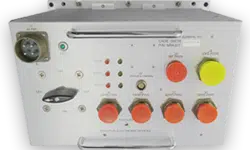
Engineered specifically for shipboard 440VAC 3-phase delta inputs. Features active PFC, ultra-low THD, and custom high-voltage DC outputs (28VDC, 270VDC, or custom rails) for naval radar and weapons systems.
- MIL-STD-1399 Section 300B Compliant
- Active PFC (> 0.98 at full load)
- Conduction or Forced Air Cooled
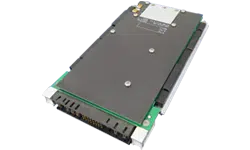
Designed for embedded naval signal intelligence (SIGINT), EW, and electronic combat suites. Offers high-density regulated power output with VITA 62 / VITA 48 (REDI) wedge-lock conduction cooling.
- SOSA™ Aligned 3U & 6U Slots
- MIL-STD-704 / MIL-STD-1275 / MIL-STD-461
- Integrated IPMI / VITA 46.11 Management
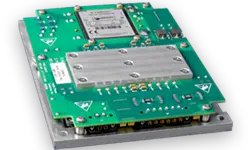
Heavy-duty isolated DC-DC converters for subsea ROVs, sonar arrays, and naval communications. Accepts 28V, 155V, or 270VDC inputs with wide transient mitigation circuits.
- Galvanic Isolation (> 1500VDC)
- Operating Temp: -40°C to +85°C Baseplate
- Overvoltage & Short Circuit Protection
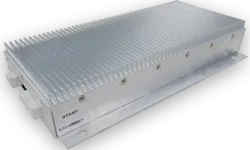
Compact, chassis-mount or 1U/2U rackmount power supplies built to meet stringent naval EMI CE102 and RE102 specs for auxiliary control systems and shipboard computing racks.
- MIL-S-901E Shock Resistance
- Conformal Coated PCBs (IPC-CC-830)
- Custom N+1 Redundancy Options
4. Industry & Technological Development Trends in Naval Power Systems
The naval defense sector is undergoing a massive shift toward electrification, high-energy payloads, and open-architecture electronics. Designers of modern Naval Shipboard Power Supplies must adapt to several disruptive technological trends:
A. Wide Bandgap (WBG) Semiconductors: Silicon Carbide (SiC) & Gallium Nitride (GaN)
Traditional silicon (Si) MOSFETs and IGBTs are approaching their physical limits regarding switching frequency and thermal dissipation. Modern naval power units increasingly leverage Silicon Carbide (SiC) and Gallium Nitride (GaN) switching components. WBG devices enable:
- Higher Power Density: Reduction in power supply volumetric size by 30% to 50%, freeing up vital space in compact submarine hulls and unmanned surface vessels (USVs).
- Superior Thermal Efficiency: Operation at significantly higher junction temperatures with drastically reduced switching losses, minimizing liquid cooling payload demands.
- Faster Transient Response: Switching speeds exceeding hundreds of kilohertz (kHz), enabling rapid regulation under dynamic pulse load conditions.
B. Pulsed Power Management & Energy Storage System (ESS) Buffering
The integration of high-energy sensors, active electronically scanned radars (such as AN/SPY-6), and directed energy weapons creates extreme pulsed power spikes on shipboard buses. Next-generation shipboard power conversion systems require bidirectional DC-DC capabilities and active energy storage buffering (supercapacitors and lithium-titanate battery interfaces) to isolate primary generators from destructive voltage sag and surge transients.
C. Modular Open Systems Approach (MOSA) & SOSA™ Alignment
The US Department of Defense (DoD) mandates MOSA compliance to eliminate proprietary vendor lock-in and accelerate modernizing naval fleets. Aegis actively designs SOSA™ (Sensor Open Systems Architecture) aligned VPX power modules, standardizing pinouts, utility signals (VITA 62), and IPMI system management interfaces across multi-vendor defense sub-assemblies.
5. Global Procurement Trends & Acquisition Strategies
Global defense buyers and procurement directors are shifting how they specify and acquire naval power electronics. Key procurement dynamics include:
- Preference for Modified-COTS (MCOTS) over Pure Custom Design: Procurement teams are balancing risk, timeline, and non-recurring engineering (NRE) costs. By starting with proven COTS base topologies and modifying form factors or output voltage rails, program managers achieve custom performance in half the development cycle.
- Total Cost of Ownership (TCO) & Corrosion Resilience: Acquisition focus has shifted beyond initial piece-part cost. Maritime power systems must provide 15+ year operational lifespans under continuous salt spray, high humidity, and vibration. Quality materials (hardcoat anodized chassis, stainless hardware, fully potted magnetics) lower long-term depot maintenance costs.
- Cybersecurity & Supply Chain Integrity (NIST SP 800-171): Naval prime contractors require total visibility into component provenance. US-based engineering and manufacturing facilities with NIST SP 800-171 cybersecurity compliance, CMMC readiness, and ITAR registration are essential to safeguard sensitive defense intellectual property and shield programs from malicious supply chain vulnerabilities.
6. Enterprise Advantages & E-E-A-T Credentials of Aegis Power Systems
When selecting a manufacturing partner for naval shipboard power conversion, experience, compliance, and verifiable quality credentials are paramount. Aegis Power Systems brings uncompromised E-E-A-T (Experience, Expertise, Authoritativeness, and Trustworthiness) to defense programs:
AS9100D & ISO 9001:2015
Certified aerospace & defense quality management system ensuring zero-defect manufacturing standards.
100% US Domestic Facility
All design, surface-mount assembly, wiring, and testing are performed in Murphy, North Carolina, USA.
ITAR & NIST Compliant
Registered with the US Department of State (DDTC) and compliant with NIST SP 800-171 data security.
Founded in 1995, Aegis Power Systems has over 30 years of engineering leadership. Our facility houses complete environmental and electrical screening infrastructure, including ESS thermal cycling chambers, HALT/HASS testing, burn-in racks, and specialized high-power AC/DC load banks. We work directly with prime contractors (such as Raytheon, Lockheed Martin, Northrop Grumman, General Dynamics, and BAE Systems) to deliver mission-critical power solutions built to survive the harshest naval operational theaters.
7. Frequently Asked Questions (FAQ) for Naval Power Supplies
Request a Technical Consultation or Proposal
Connect directly with our senior power conversion engineering team to discuss your shipboard electrical requirements, MIL-STD specifications, or custom procurement timelines.