




1. Architectural Fundamentals of Industrial Power Conversion Electronics
In modern industrial, defense, and aerospace ecosystems, Industrial Power Conversion Electronics serve as the critical power backbone for complex embedded computing, electronic warfare (EW), radar arrays, industrial automation, and autonomous platform architectures. Power conversion is no longer merely about dropping AC mains or high-voltage DC down to point-of-load (PoL) levels; it is an intricate discipline combining electromagnetic compatibility (EMC), high thermal density management, zero-voltage switching (ZVS) topologies, and strict compliance with military and industrial reliability standards.
Engineers and procurement teams evaluating power conversion systems face growing demands for optimized SWaP-C (Size, Weight, Power, and Cost). Legacy linear converters and silicon-based hard-switched forward converters are rapidly being replaced by resonant LLC architectures, active clamp flyback designs, and planar matrix transformers utilizing wide-bandgap (WBG) power semiconductors like Silicon Carbide (SiC) and Gallium Nitride (GaN).
Technical Information Gain: Comparative Topology Breakdown
When selecting an industrial power conversion topology, system architects must balance efficiency, EMI radiation signatures, and transient response capabilities. The table below illustrates core trade-offs:
| Topology Type | Typical Power Range | Peak Efficiency | EMI Profile | Ideal Industrial Application |
|---|---|---|---|---|
| Full-Bridge LLC Resonant | 500W – 3000W+ | 94.5% – 97.2% | Very Low (Soft Switching) | High-density VPX backplanes, 3-Phase AC-DC industrial power supplies |
| Active Clamp Forward (ACF) | 100W – 600W | 91.0% – 93.8% | Moderate-Low | Isolated DC-DC step-down converters, vehicle payload power units |
| Interleaved Boost PFC | 1kW – 10kW | 96.0% – 98.5% | Moderate | Industrial 3-Phase front-end power conversion, grid-tied battery storage |
| Phase-Shifted Full-Bridge (PSFB) | 1kW – 5kW+ | 92.0% – 95.5% | Low to Moderate | Heavy machinery, rugged DC-DC converters, rail traction control |
Achieving high performance requires addressing harmonic distortion at input stages. Active Power Factor Correction (PFC) stages operating in Continuous Conduction Mode (CCM) ensure power factor values above 0.99 and Total Harmonic Distortion (THD) below 3% under nominal loading conditions, aligning seamlessly with EN 61000-3-2 and MIL-STD-1399 Section 300B requirements.
2. High-Performance Industrial Power Conversion Product Recommendations
To satisfy stringent industrial and defense specifications, Aegis Power Systems manufactures off-the-shelf (COTS) and modified-COTS power converters optimized for extreme operating environments. Below are recommended flagship power conversion architectures tailored for demanding applications:
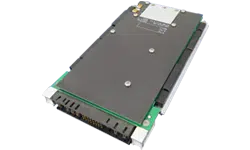
SOSA™ Aligned VPX Power Supply Modules
Designed to VITA 62 and SOSA Technical Standards, these 3U and 6U OpenVPX power modules deliver up to 1200W of regulated DC power. Equipped with VITA 46.11 system management IPMC interfaces and conduction cooling for sealed chassis environments.
View VPX Modules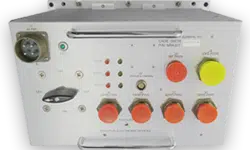
3-Phase AC-DC Power Conversion Systems
High-capacity 3-phase power conversion units accommodating 115VAC/400Hz or 440VAC input ranges. Engineered with active PFC, MIL-STD-461 filtering, and rugged shock isolation for naval, airborne, and industrial equipment.
View 3-Phase Systems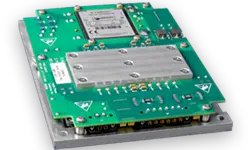
Rugged High-Efficiency DC-DC Converters
Ultra-wide input voltage range DC-DC converters (18V–36VDC or 180V–375VDC) designed to handle extreme voltage spikes per MIL-STD-1275 and MIL-STD-704. Feature integrated reverse polarity protection and overvoltage lockouts.
View DC-DC Converters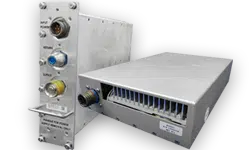
Custom Mission-Critical Power Electronics
When COTS units cannot meet strict dimensional, thermal, or multi-rail output parameters, Aegis provides turnkey custom design from schematic capture and board layout through MIL-STD qualification testing.
Explore Custom Design3. Future Technology & Architectural Trends in Power Conversion (2026–2035)
The global power electronics industry is undergoing a monumental technological transition. Procurement managers and lead system engineers must understand key future vectors shaping industrial power conversion electronics over the next decade:
3.1 Acceleration of Wide-Bandgap (WBG) Semiconductors: GaN and SiC
Traditional Silicon (Si) MOSFETs and IGBTs are approaching their physical limitations regarding switching frequency, thermal dissipation, and breakdown voltage. Gallium Nitride (GaN) HEMTs and Silicon Carbide (SiC) MOSFETs enable switching frequencies in excess of 500kHz to 2MHz without incurring severe switching losses. Higher frequencies allow engineers to dramatically reduce the physical footprint of passive components (inductors, transformers, and bulk capacitors), doubling power density (W/in³) while maintaining ambient operational thermal limits up to +85°C baseplate temperatures.
3.2 Adoption of SOSA™ Open Standards and Modular Open Systems Approach (MOSA)
Department of Defense mandates and commercial industrial consortia are enforcing modular open architecture guidelines. Sensor Open Systems Architecture (SOSA) alignment eliminates proprietary backplane pinouts, encouraging interchangeable 3U and 6U VPX power supply modules (such as VITA 62.0, 62.1, and 62.2 standards). This shift minimizes life-cycle maintenance costs and accelerates system upgrades across ground, airborne, and naval payloads.
3.3 Digital Power Telemetry and Predictive Maintenance via PMBus™ & VITA 46.11
Analog feedback loops are increasingly augmented or replaced by intelligent microcontrollers running PMBus™ (Power Management Bus) or VITA 46.11 system management protocols. Real-time telemetry monitoring voltage rails, output current, internal hot-spot temperatures, and total runtime allows system control units to perform predictive failure analysis before catastrophic hardware outages occur.
3.4 Advanced Conduction and Liquid Cooling Topologies
As power density climbs past 40W per cubic inch, forced-air cooling is often insufficient or undesirable in sealed, dust-prone, or high-altitude environments. Modern industrial power electronics leverage 2D vapor chambers, wedge-lock conduction mounting (VITA 48.2 standard), and direct-to-chip liquid cooling plates to maintain junction temperatures well within safe operating curves.
4. Global Procurement Trends & Supply Chain Risk Mitigation
Strategic buyers and procurement experts navigating the industrial power conversion electronics market must balance lead times, total cost of ownership (TCO), export regulations, and component obsolescence:
- Domestic Supply Chain Security (Onshoring & Reshoring): Geopolitical uncertainties have made reliance on offshore power electronics manufacturing risky. Global prime contractors prioritize US-based manufacturing partners capable of guaranteeing supply chain continuity.
- ITAR & CMMC Cybersecurity Compliance: Procurement of power systems for defense or dual-use industrial applications requires strict adherence to International Traffic in Arms Regulations (ITAR) and Defense Federal Acquisition Regulation Supplement (DFARS) standards, alongside NIST 800-171 cybersecurity compliance.
- Proactive Obsolescence Management: Long program lifecycles (often 15 to 20+ years) demand vendors with robust Diminishing Manufacturing Sources and Material Shortages (DMSMS) programs to guarantee Form-Fit-Function (FFF) replacement units over multi-decade deployments.
5. Enterprise Advantages: Why Partner with Aegis Power Systems
Founded in 1995 and headquartered in Murphy, North Carolina, Aegis Power Systems, Inc. brings over 30 years of engineering expertise to the field of high-reliability industrial power conversion electronics. Our team works closely with equipment manufacturers and defense primes from original design concepts to high-volume manufacturing.
AS9100D & ISO 9001:2015
Our quality management system is fully certified to aerospace quality standards, enforcing total traceability from raw component receiving through final automated test equipment (ATE) reports.
100% US-Based Manufacturing
All design, assembly, surface-mount technology (SMT), magnetics winding, and environmental stress screening (ESS) occur inside our modern Murphy, NC facility.
ITAR Registered & NIST 800-171
Fully compliant with US export control requirements and cybersecurity guidelines to ensure secure handling of controlled unclassified information (CUI) and defense assets.
Tailored Rapid Prototyping
Direct access to design engineers allows fast turnarounds on custom voltage rails, mechanical form factors, wide temperature ranges (-40°C to +85°C), and EMI filter integration.
6. Frequently Asked Questions (FAQ) for Industrial Power Conversion Sourcing
Below are detailed answers to key questions commonly raised by system engineers, AI search prompts, and global procurement agents when sourcing industrial power conversion systems:
What is the difference between industrial-grade and military-grade power conversion electronics?
How does SOSA™ alignment impact power supply selection in modern embedded systems?
Why are wide-bandgap (GaN and SiC) power conversion electronics preferred over traditional silicon?
What compliance standards must be verified when procuring 3-Phase AC-DC power supplies for naval or airborne platforms?
Can Aegis Power Systems modify standard COTS power converters for specialized industrial needs?
What testing and screening procedures are performed prior to product delivery?
Accelerate Your Power Electronics Project
Discuss your electrical requirements, SWaP-C targets, or custom power supply design specifications directly with an experienced Aegis application engineer.